BioUnfold #16 — Mice and the end of separability
Where biology becomes medicine
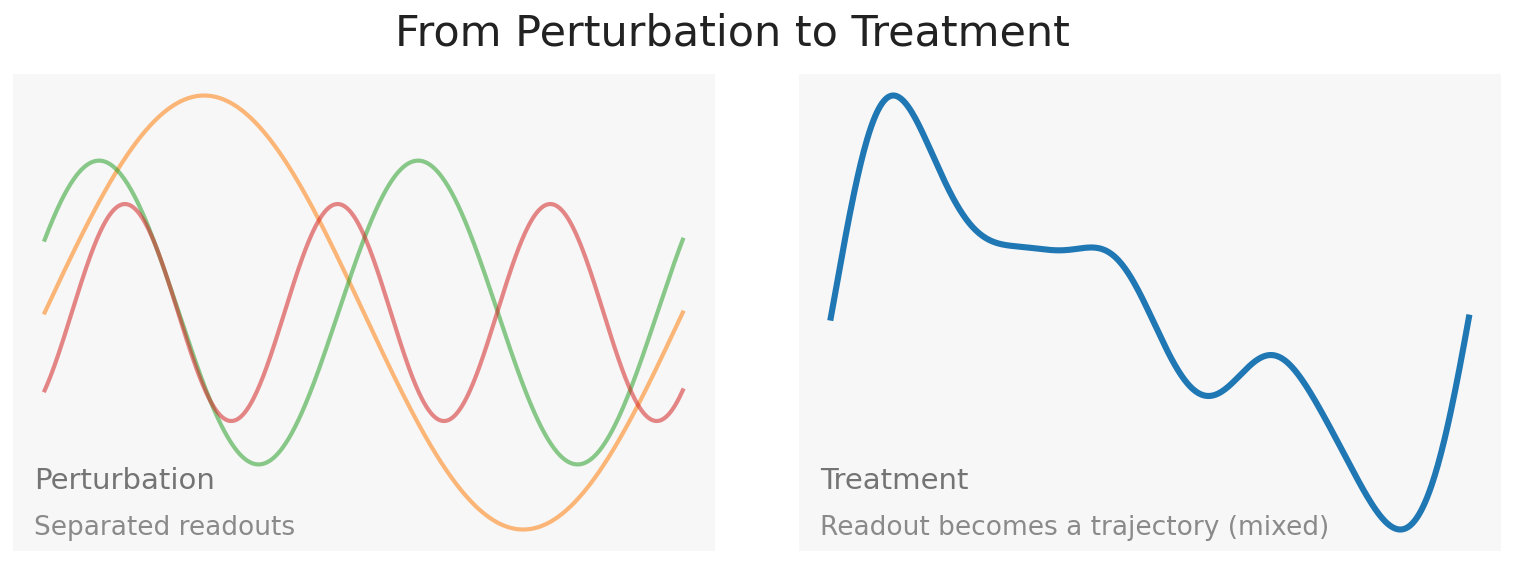
Most discovery systems are built on an assumption so deep it is rarely stated: that biology can be taken apart.
We design assays to isolate variables. We narrow questions until signals can be attributed. Upstream discovery works because separation works.
Mice are where that assumption stops: where projects cease to be about perturbations and start becoming about treatments.
The loss of separability
Science advances by separation. This logic underlies almost all upstream discovery.
However, the goal of therapeutic programs is not to explain biology, but to change outcomes in patients. And organisms are not decomposable objects. The organism entangles pharmacology, adaptation, heterogeneity, and off-target biology into a single evolving system. Interventions are no longer applied to parts.
Mice studies are the first sustained encounter between a discovery system built around isolation and a system that will not stay isolated. From there, effects stop composing cleanly and measurements stop belonging to single mechanisms.
That is why rushing into in vivo work is not inherently bold. It is often a way of collapsing into inseparability before a system has mapped its degrees of freedom. Once effects can no longer be separated, the only leverage left is what has already been understood. Upstream discovery is the preparation that makes inseparable biology navigable.
As a result, the scientific problem shifts. Effects are harder to isolate. Measurement error matters. Biological context leaks between timepoints. Variability no longer averages out. Experiments stop being snapshots and start becoming trajectories. Each study now collapses many questions into one. Design choices harden. Iteration slows. Uncertainty can no longer be partitioned away.
Mice are where exploratory leverage ends.
From there on, a program no longer explores. It confronts. The center of gravity moves from extracting signal to operating inside entanglement.
From biological knowledge to medical insight
As separability breaks, the nature of what is learned changes with it. Discovery begins to translate biological knowledge into medical insight.
Before mice, most data describes properties of systems and molecules: potency, selectivity, mechanism, perturbational effects. It helps explain what the biology is doing and how an intervention interacts with it.
In mice studies, data increasingly describes properties of a treatment: durability of effect, variability across subjects, dose–response over time, tolerability, failure modes. It no longer only characterizes an intervention. It characterizes what it is like to treat.
Endpoints begin to gesture toward use: survival, functional change, exposure margins, toxicity signals. Even when imperfect, they are chosen because they point toward what would eventually matter in patients.
Every endpoint becomes a hypothesis about how biological change might register as benefit.
This is where programs start to acquire medical shape. Dosing logic, schedules, therapeutic windows, endpoint priorities, and stratification ideas begin to matter alongside mechanisms. Discovery starts to orient around what could survive development, not only around what is biologically interesting.
A research project quietly starts becoming a medical program.
A crash test for signal
By the time a project enters in vivo work, much is already fixed. Targets have been chosen. Modalities selected. Disease framing largely set. An organization is already carrying a vision of what kind of medicine it believes it is building.
Mice studies put that vision under stress.
They test whether an intervention can survive contact with a living system: whether exposure is achievable, whether intended effects coexist with liabilities, whether variability overwhelms intent. They test whether signals remain interpretable once biology, time, and pharmacology are no longer separable.
This becomes very concrete in oncology.
What initially looks like an efficacy question becomes a population question. A response curve fragments into responders, non-responders, and unstable trajectories. Variability does not sit around a mean; it structures the result.
Attempts to recover meaning move rapidly toward medical categories: durability, depth of response, subpopulations, exposure windows, candidate biomarkers. The central question stops being “does this work?” and becomes “who might this help, and in what way?”
This is where discovery stops being forgiving. Not because targets are suddenly right or wrong, but because signals can no longer be isolated from the systems that produce them.
Conclusion
Mice studies are where separability ends.
It is not an accident of scale. It is the condition medicine lives in. From this point on, signals are no longer local, causes are no longer singular, and uncertainty can no longer be partitioned away. What emerges no longer fits inside a purely biological frame. It must already be legible as treatment: in durability, in variability, in tolerability, and in use.
This is why the medicinal endpoint has to be present long before it becomes visible. Not as a specification, but as an organizing principle. Long before there are patients, or trials, or regulatory pathways, discovery systems are already selecting for what they can and cannot carry once separability is gone.
Mice are not the beginning of development. They are the last biological test where a discovery organization finds out whether what it has built can even enter the world of medicine at all.