BioUnfold #25 — Intelligence as Execution
How value is created under constraint in biotech
The value of a traditional biotech is not its products. A molecule can generate significant revenue, but its value does not compound. It is fixed in its intellectual property and exposed to competition, substitution, and time. Products sustain a company, but they do not make it grow.
What drives growth is the ability to generate future products. That ability depends on whether the underlying assets of the company are passive or active. Intelligence is what makes assets active. In this model, value comes from continuously replacing declining assets with new ones, which makes the most valuable asset not any individual product, but the system that produces the next one.
An intelligent platform explores the space of possibilities more effectively by combining three elements: relevant data, reasoning, and execution. Data provides observations. Reasoning connects them to hypotheses. Execution turns those hypotheses into actions that change the system: running experiments, prioritizing programs, advancing or terminating assets. These elements only create value together. Data without reasoning is inert. Reasoning without action is unrealized. Execution without relevance is waste.
Data Compounds Only When It Transfers
The value of data is not defined by its volume, but by its relevance to future decisions. A specialized assay can be highly informative for a narrow problem. A broader profiling experiment may be less precise but applicable across many contexts. A hit-finding campaign can generate clean, reproducible data tightly coupled to a single mechanism, but that value declines outside it.
Data does not expire, but its relevance does. As the problem shifts, previously collected data may no longer constrain decisions. For data to become an active asset, it must transfer. It must inform decisions beyond the experiment that generated it. Without transferability, data accumulates but does not compound.
Most discovery systems are optimized for accumulation: more experiments, more measurements, more results. But accumulation alone does not create value. Value emerges when data improves the system’s ability to make better decisions over time. Each experiment should not only produce a result, but update what the system does next. The system becomes directional. Its trajectory improves. Intelligence is not defined by how much a system knows, but by how effectively it updates itself.
Execution Defines the Boundary of Value
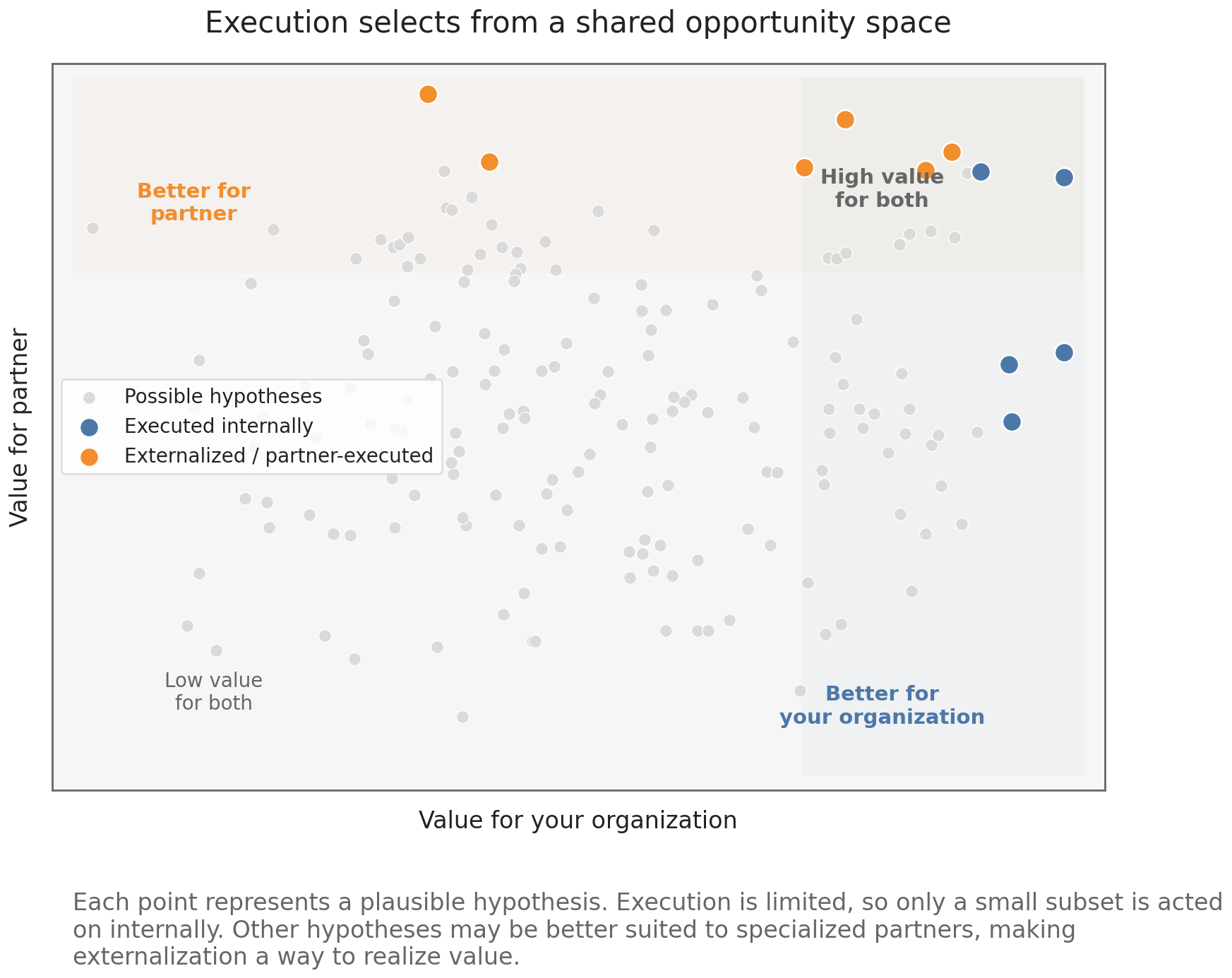
In modern discovery, storing data and applying reasoning are becoming increasingly cheap. Models can generate and evaluate large numbers of hypotheses, allowing the system to explore a vast space of possibilities. Execution does not scale in the same way. Generating new data requires designing and running experiments, allocating capital, and committing attention. Each action changes the system and cannot be fully reversed. A system may generate thousands of plausible hypotheses, but can only test a small subset.
The constraint is no longer generating ideas. It is deciding which ideas to act on. Data grows linearly. Reasoning expands combinatorially. Execution remains bounded. The central question becomes which hypotheses should be tested out of all those that could be. This is where intelligence matters: allocating execution under constraint.
Execution capacity is finite. Even the most advanced platform cannot act on all the hypotheses it generates. If a system produces more opportunities than it can execute, a large fraction remains unexploited. This creates an execution boundary. Within that boundary, the company captures full value by advancing its highest-confidence opportunities. Beyond it lies latent value: hypotheses that are credible but cannot be prioritized internally.
Value is only realized through action. Data and reasoning represent potential, but without execution they do not change outcomes. Identifying a signal or a lead does not create value until a decision advances the system. When execution is constrained, part of that potential remains unused. Externalizing parts of the system then becomes a way to capture it through partnerships, licensing, or platform access. This is not a fallback, but a consequence of limited execution capacity. The question is not whether to monetize intelligence, but where to draw the boundary between what is executed internally and what is externalized after sufficient execution establishes credibility.
Biotech has traditionally been organized around products: assets that generate revenue but do not compound. The emerging model is organized around intelligence: systems that improve their ability to generate and select new assets over time. In this model, data is only valuable if it transfers. Reasoning is only valuable if it guides action. Intelligence is only valuable if it allocates execution effectively under constraint.
The limiting factor is not how much a system can observe or imagine, but how well it decides what to do next. Building an intelligent platform is not about collecting more data or building better models in isolation. It is about constructing a system where each action improves the next, and where the boundary between what is explored and what is executed is deliberately controlled. That is where value compounds.