BioUnfold #29 — We Observe Disease States, Not Diseases
Drug discovery is often framed as the search for the right target. This framing has been remarkably successful because it reduces a complex disease to a manageable intervention point. By identifying a biological mechanism involved in a disease process and finding a way to modulate it, researchers have developed therapies for cancer, autoimmune disorders, and rare genetic diseases.
The challenge is not that targets are wrong. The challenge is knowing which target matters.
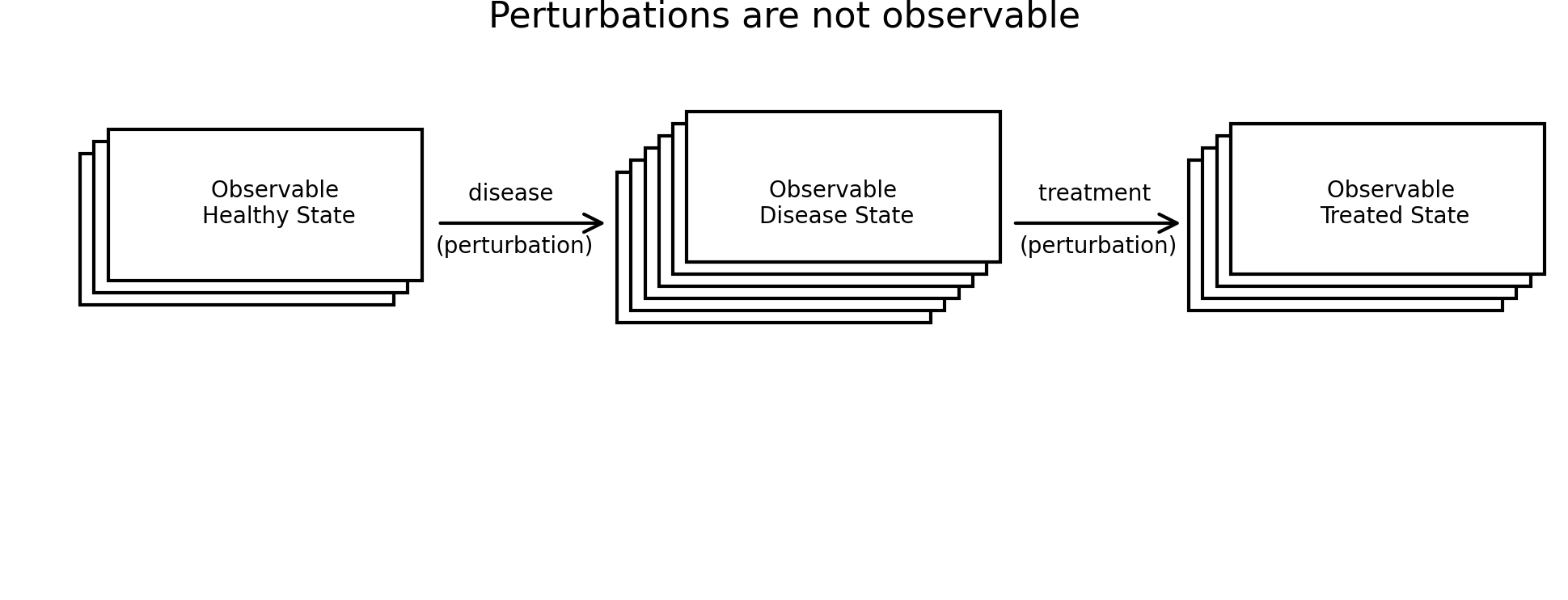
A mutation, chronic inflammation, infection, or aging process can all be viewed as perturbations of a biological system. The difficulty is that we rarely observe these perturbations directly. Instead, we observe the states they create through transcriptomics, imaging, biomarkers, and clinical symptoms. Drug discovery therefore begins with an inference problem: reconstructing the perturbations that matter from the states we can measure.
Chronic Diseases Blur Cause and Consequence
This problem becomes particularly visible in chronic diseases.
In an acute disease, the perturbation remains relatively easy to identify. An infection triggers an immune response, a wound activates repair mechanisms, and recovery follows once the cause is removed. Cause and consequence remain closely linked.
Chronic diseases behave differently because the perturbation persists. Genetic mutations, chronic inflammation, protein aggregation, and aging continuously alter the system. Over time, the organism adapts. Pathways are rewired, compensatory mechanisms emerge, and cell states change.
As a result, the disease state eventually reflects both the original perturbation and the biological response to it.
This creates a practical question for drug discovery: should we target the original perturbation, the adaptation that follows, or both?
Many of the most challenging diseases may owe their complexity to the fact that these two become increasingly difficult to separate. A mutation may initiate pathology, but years later the biological adaptations generated by that mutation may contribute as much to disease progression as the mutation itself. The disease is no longer merely a consequence of the original perturbation. It increasingly becomes a consequence of the system adapting to live with it.
Why Observation Is Not Enough
Modern drug discovery is built on comparing healthy and diseased states. Single-cell technologies, transcriptomics, and large-scale patient datasets have dramatically increased our ability to do so.
The problem is that differences do not necessarily reveal what should be changed.
The same perturbation can produce different outcomes depending on context, while different perturbations can converge toward similar disease states. Correlation and causation become increasingly difficult to separate as biological systems adapt over time.
This is why target discovery remains difficult despite the abundance of data. The challenge is not generating observations. The challenge is determining which observations correspond to causes, which correspond to adaptations, and which are merely consequences.
Disease-versus-healthy comparisons can only take us so far.
Pathways help organize this complexity because they describe how perturbations propagate through biological systems. Yet pathways are themselves context dependent. Understanding a pathway interaction does not necessarily reveal whether it is driving the disease, compensating for it, or simply responding to it.
Perturbation as a Tool for Understanding
The most reliable way to understand a biological system is often to perturb it.
A disease perturbs a biological system. A drug perturbs that same system. Both propagate through pathways, depend on context, and trigger adaptation.
Viewed this way, perturbation is not only a therapeutic strategy. It is also a tool for understanding.
The goal of drug discovery is not simply to identify targets or measure disease states. It is to find interventions that reveal which perturbations matter, distinguish disease from adaptation, and ultimately identify targets that address both the original disturbance and the biological responses that sustain it.
This perspective may help explain why some therapeutic modalities feel fundamentally different from traditional drug treatments. Most drugs compensate for a chronic perturbation by introducing a second chronic perturbation. The treatment remains necessary because the original disturbance remains present.
The ideal outcome is different. Rather than continuously opposing a perturbation, it is to transform a chronic problem into an acute intervention, modify the system once, and allow biology to establish a new equilibrium.
Not every disease can be approached this way, but the distinction is useful. Acute perturbations are often easier to understand because cause and consequence remain closely linked. Chronic perturbations are harder because adaptation becomes part of the disease itself.
Understanding disease therefore requires more than observing biological states. It requires perturbing systems in ways that reveal which disturbances matter, which responses are adaptive, and which have become part of the pathology we are trying to treat.